Wachau
World Heritage Site
The striking appearance of the castle town of Dürnstein in the Wachau World Heritage Site has impressed not only kings and princes but also ordinary people since the early Middle Ages.

The History of Dürnstein
With its picturesque alleyways, the imposing ruins of Dürnstein Castle and its unique setting on the Danube, Dürnstein is a truly fascinating destination. The history and beauty of this town attract visitors from all over the world and allow them to immerse themselves in times gone by.
Evidence of medieval life can be seen in the castle towering high above the Danube, the town with its monastic complexes, and the fortifications winding their way through the rugged terrain. The Baroque renovation of the Augustinian monastery under the supervision of Provost Hieronymus Übelbacher, along with other modern construction projects, radically altered the appearance of the most important town of the Kuenring dynasty. Furthermore, these developments subsequently influenced the history of the Hotel Richard Löwenherz.


700 years of history
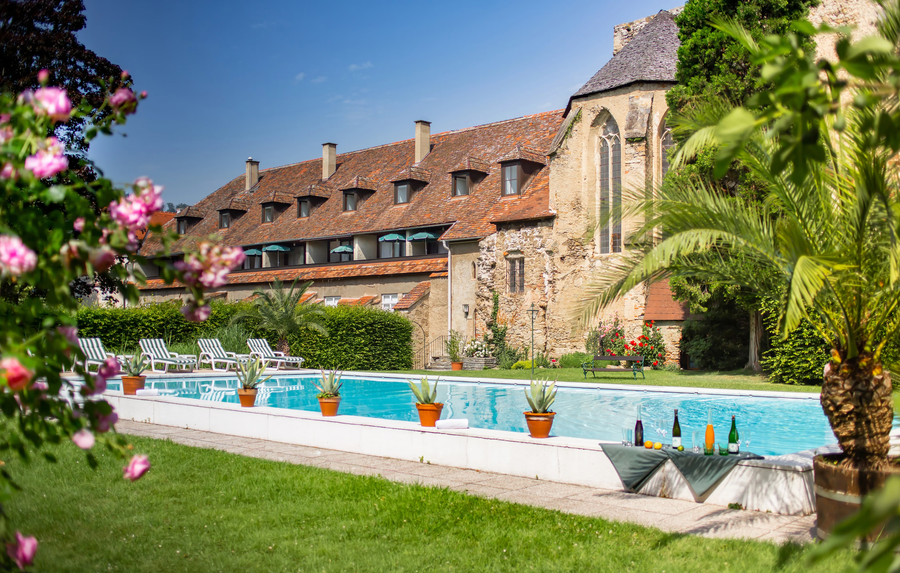
Once a Poor Clare convent, it was initially run as an inn in 1880, before being converted into a hotel in 1938.


The history of our hotel
From Monastery to Hotel-Restaurant Richard Löwenherz
In 1289, the powerful Leuthold I of Kuenring donated the Hager House and the Schenking estate in the south-east of Dürnstein to the Poor Clares’ convent he had founded. Leuthold referred to his beloved convent and the Wachau as “nobilis districtus”. By around 1340, the High Gothic, two-aisled church was probably completed, where Franciscan friars from Stein administered the sacraments to the devout women. Donations from the sovereign, the Kuenring family and relatives of the nuns soon helped the foundation to flourish. However, the Reformation and the burden of wartime levies had such a severe impact that the convent was dissolved around 1570.
The property subsequently passed to the Augustinian Canons’ monastery located in the centre of the small town, which found its great reformer in Provost Hieronymus Übelbacher (1710–1740). He sought to remodel his church in keeping with the new architectural style of the time and, in doing so, sacrificed a number of valuable historic elements. The large cellar in front of the Kremser Tor was expanded, the Poor Clares’ church was stripped of its sacred furnishings, the ridge turret and high church roof were removed, and the Gothic windows were bricked up. In this way, the two-aisled Gothic church was transformed into a granary.
Through the trade in wine and grain, Provost Übelbacher financed the construction and renovation of his monastery. The cloister of the Poor Clares was also demolished and the convent rooms were converted for commercial use. In 1798, the Augustinian Canons’ monastery was dissolved and the buildings were transferred to Herzogenburg Abbey. In 1820, the former Poor Clares’ convent finally passed into private ownership.
Since the fin de siècle, the Thiery family, with its French Huguenot roots, has shaped the history of the house. What began during the Belle Époque in the early 1880s, among other things as a meeting place for artists and guests, developed over the decades into an inn and later into a hotel with a reputation extending far beyond the region. Since 1890, the former Poor Clares’ convent has borne the name “Richard Löwenherz” – Richard the Lionheart – in memory of the English king who was held captive in Dürnstein from 1192 to 1193.
The historic ensemble stretches along Dürnstein’s centuries-old town wall and continues to combine medieval architecture with a living tradition of hospitality. Step by step, the former boatmen’s inn evolved into today’s Hotel-Restaurant Richard Löwenherz, now run by the fourth generation of the Thiery family, with the fifth generation already helping to shape the future of the house.
At the end of the 1930s, the former Starhemberg castle to the west was added to the property. Initially operated as an extension of the original hotel, it was gradually developed over many years. Since 1970, Schloss Dürnstein has been run as an independent business. Together, the original house and the castle continue to tell the long story of the Thiery family in Dürnstein.
This close connection with history and hospitality also continues in the centre of the small town, where romantic holiday apartments are operated under the name Aliénor d’Aquitaine.
Only a few years now separate the Thiery family from the 150th anniversary of their tradition as hosts in the former Poor Clares’ convent. To this day, Hotel-Restaurant Richard Löwenherz stands for personal hospitality, living tradition and a unique combination of historic architecture, culture and contemporary comfort – in the heart of the UNESCO World Heritage Wachau region.